
L.A.’s Maternity Ward Crisis: Why More Patients Are Ending Up In Emergency Rooms For Birth Care
Why L.A. County’s Maternity Ward Closures Are Sending More Patients To Emergency Rooms

Los Angeles County is facing a growing maternity care crisis, and doctors say the problem is bigger than hospital closures.
Since 2013, 17 maternity wards have closed in L.A. County, reducing access to local labor and delivery care across the region. According to Dr. Reza Babapour, M.D., the closures are tied to a deeper shortage of OB/GYNs, midwives, primary care physicians, and public investment in healthcare access — especially in lower-income communities.
The result: more patients are turning to emergency rooms for birth care.
From 2016 to 2023, more than 26,500 people went to L.A. County emergency rooms seeking birthing care, with Latino patients making up a major share of those visits, according to reporting cited by Dr. Babapour.
For advocates, that number points to a system that is failing patients before they ever reach the hospital.
“There is no system to care for these women,” Dr. Babapour wrote in response to TodayLA’s interview questions.
A shortage of doctors, midwives, and maternity wards
Dr. Babapour says the crisis is being driven by several overlapping issues: a shortage of OB/GYNs, a shortage of midwives, low Medi-Cal reimbursement rates, and a lack of long-term investment in training enough physicians for L.A. County’s population.
He cited California Health Care Foundation data showing that L.A. County has 10.6 OB/GYNs per 1,000 live births, compared with 12 per 1,000 live births nationally and 15.3 per 1,000 live births in the Greater Bay Area.
The gap is even wider for midwives. L.A. County has 17 midwives per 10,000 live births, compared with 54.9 per 10,000 live births in the Greater Bay Area, according to the data Dr. Babapour cited.
“These ratios are unevenly distributed across the County, with affluent communities having far more doctors than the poorer communities,” he wrote.

The hardest-hit communities
The communities facing the deepest gaps include East L.A., South L.A., South Central, Antelope Valley, and other economically disadvantaged parts of Los Angeles County, according to Dr. Babapour.
He says these areas are not only facing maternity care shortages, but broader shortages in primary care, mental health care, pediatrics, dermatology, psychiatry, and other specialties.
In South L.A., he noted, diabetes rates are significantly higher than in other parts of the county, and preventable hospitalization rates are among the highest in the region.
Dr. Babapour also pointed to a stark life expectancy divide: residents of Westwood live 16 years longer than residents of Sun Village in Antelope Valley, according to Measure of America data he cited.
More deputies than primary care doctors
One of the most striking comparisons in the interview: Dr. Babapour says L.A. County has 100 sworn deputies per 100,000 residents, compared with 58 primary care physicians per 100,000 residents.
His point is not just about numbers. It is about priorities.
“When patients need help, it is simply not available,” he wrote. “As a result, their conditions that can easily be treated in a doctor’s office become so chronic and life threatening that they have no other option but to end up in emergency rooms.”

The proposed solution: a new public medical school
Dr. Babapour says L.A. County needs to address the root cause of the shortage by investing in a new public medical school.
He argues that since UCLA’s publicly funded medical school was established in 1951, when the county’s population was about 4.5 million, L.A. County has grown dramatically without creating another public medical school to meet the needs of its most vulnerable residents.
A UCLA student coalition, @UCLA_ReformLAHealth, has joined the campaign calling for a new public medical school in L.A. County. According to Dr. Babapour, more than 800 UCLA pre-health students have signed a petition, along with nearly 2,450 Angelenos on Change.org.
For Dr. Babapour, the question is urgent: will L.A. County invest in healthcare access before the crisis gets worse?
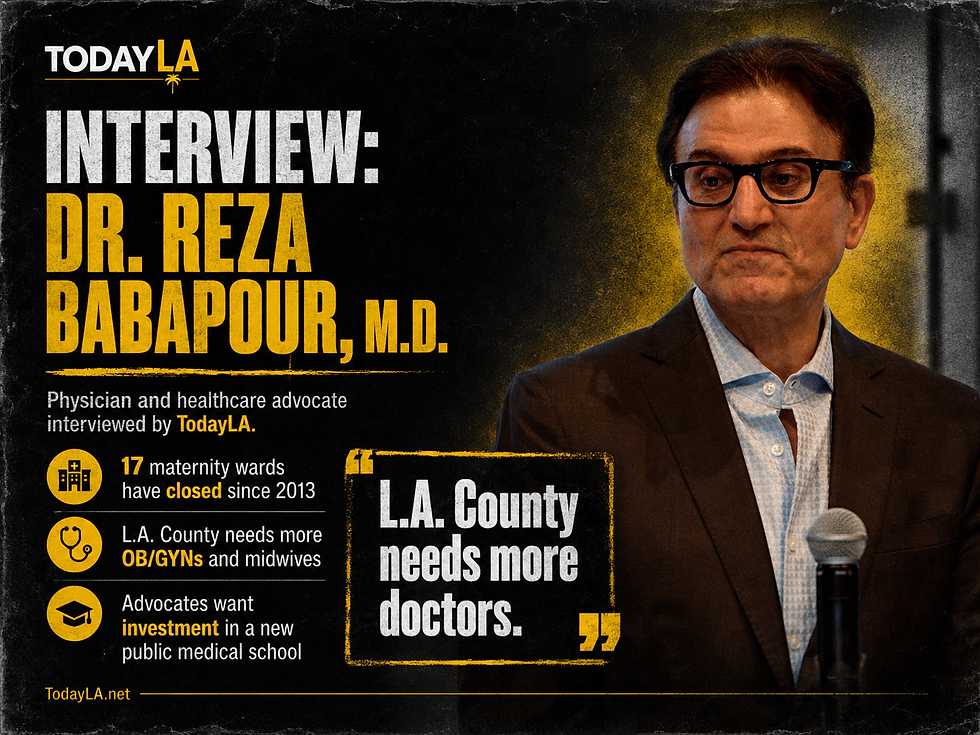
TodayLA Interview: Dr. Reza Babapour, M.D.
TodayLA: What is happening to maternity care access in Los Angeles County right now?
Dr. Reza Babapour:Due to shortages of obstetricians, OB/GYNs, and midwives, as well as low Medi-Cal reimbursement rates, 17 maternity wards in L.A. County have closed since 2013.
He said L.A. County has also struggled with shortages across maternal care, reproductive care, primary care, mental health care, and other specialties.
TodayLA: Why are more patients ending up in emergency rooms for birth care instead of maternity wards?
Dr. Babapour:There are so few doctors in some communities that when patients need help, care is simply not available. Conditions that could be treated earlier in a doctor’s office can become chronic or life-threatening, forcing patients into emergency rooms.
He pointed to a broader lack of preventive care in underserved communities, saying residents often end up in the ER when treatable conditions become advanced.
TodayLA: The Guardian reported that from 2016 to 2023, more than 26,500 people went to L.A. County ERs seeking birthing care, mostly Latino patients. What does that number tell you?
Dr. Babapour:He said the number reflects a persistent physician shortage that has been especially harmful to marginalized communities, particularly communities of color.
He also noted that access to OB/GYN care is extremely difficult in East L.A., South L.A., and other low-income communities, even as Black mothers in L.A. County face mortality rates up to four times higher than other women.
TodayLA: Which communities in L.A. County are being hit the hardest, and why?
Dr. Babapour:East L.A., South L.A., South Central, Antelope Valley, and other economically disadvantaged communities are being hit hardest.
He said these communities face inequities in access to care, quality of care, and the number of available doctors. Antelope Valley, he said, has a high rate of preventable hospitalization and needs urgent attention.
TodayLA: What is the most urgent thing L.A. leaders need to do right now?
Dr. Babapour:L.A. County needs to invest in training more doctors.
He said California’s physician workforce is aging, with many doctors over age 60 expected to retire or reduce their hours soon. In Los Angeles, he argues, the county is not producing enough doctors to replace them.
His proposed solution is the creation of a new public medical school in L.A. County focused on serving underserved communities.



Comments